Arkansas Consumer Confidence Reports: Find Any City Water Test Online
Finding the right water test can be harder than it sounds: a city may use a regional supplier, a utility name may not match the town name, and an annual report is not the same as a test from your kitchen tap. Here’s how to locate an Arkansas Consumer Confidence Report, check that it covers your service area, and understand what it can—and cannot—tell you.
What an Arkansas Consumer Confidence Report tells you
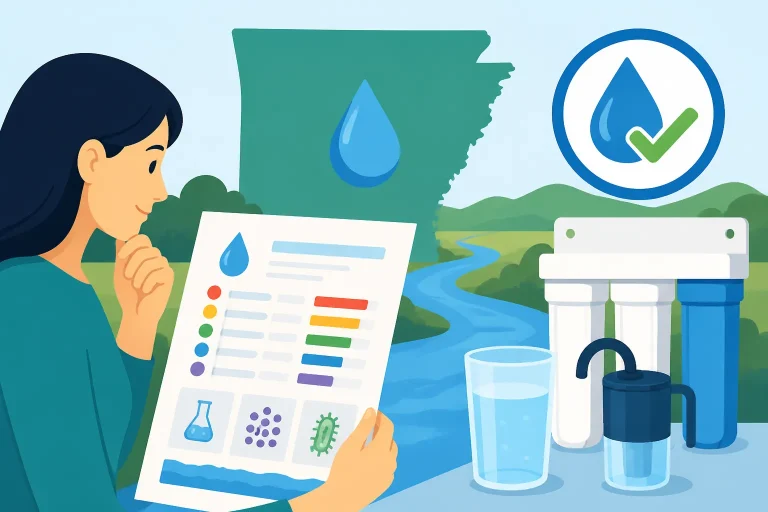
A Consumer Confidence Report, often shortened to CCR, is an annual report about water from a community water system. According to the Arkansas Department of Health, Every community water system must prepare and make available to all customers an annual report. The report describes the system’s water source and water quality, including contaminant detections or violations.
The Arkansas Department of Health page lists Consumer Confidence Reports for your drinking water. That makes the page a practical starting point when you want to find a city water quality report online. You can also check the water provider’s own website, especially if you know the name on your bill but are unsure how it appears in the state’s listing.
A CCR is useful for answering questions such as:
- Which water system serves this address?
- What source does the system describe?
- Which contaminants does the report discuss?
- Does the report describe detections or violations?
- Is the report for the service area you are trying to check?
The answers apply to the water system and the reporting period described in the document. A CCR is not a lab analysis of water collected from your particular faucet. It also cannot tell you, by itself, whether your home’s plumbing changes the water between the utility’s system and your tap. For that distinction, see City Water Report vs Your Tap: Why Fixtures Show Different Results.
This difference matters whether you are checking a home you already live in, comparing neighborhoods, or reviewing water information before buying a house. A CCR can give you an important system-level picture, but it is one piece of the puzzle. It is most useful when you confirm the provider, read the report’s stated coverage, and separate system information from concerns that are specific to your home.
If you are new to the way public water service is organized, Guide to Arkansas Public Drinking Water Systems can help clarify why the company or system name on a report might not be the town name you searched for.
How to find a city water report online
Start with the service address or the name of the water provider shown on a bill. A town name is a helpful clue, but it is not always enough to identify the system. Water service areas do not necessarily follow city boundaries, and some communities receive water through a regional arrangement. The provider for a home may have a different name from the municipality where the home is located.
The Arkansas Department of Health’s report page is a useful first stop because it lists drinking water Consumer Confidence Reports. If you do not immediately recognize a system name, do not assume the report is missing. Compare the name on the state page with the name on your bill, the utility’s official website, or the information provided by the seller or property manager.
A reliable search process looks like this:
- Find the water provider’s name on a recent bill, service notice, or account record. If you do not have one, ask the property owner, seller, or manager which provider serves the address.
- Open the Arkansas Department of Health page for Consumer Confidence Reports and look for the system that appears to match the provider.
- Check the provider’s official website for its water quality or Consumer Confidence Report page. A utility may also offer a report through a customer-information section or a search tool.
- Compare the system name in the report with the provider name you have. If they differ, look for an explanation on the provider’s official site or contact the provider using current details from that site.
- Open the report and confirm that its stated system and reporting period match what you need.
- Save the document or note the official page where you found it, so you can return to the same report if you need to compare details later.
If the state listing is difficult to navigate, search the provider’s name together with terms such as “Consumer Confidence Report” or “water quality report.” Treat search results as a way to locate a document, not as proof that it is the correct one. Confirm the result on an official provider or Arkansas Department of Health page before relying on it.
A nearby city’s report is not a substitute for the report covering your address. Two places can be close together yet served by different systems. The reverse can happen too: homes in different communities may share a provider or receive water through a regional arrangement. The address-to-provider match matters more than the city label in a search.
When the provider’s name is unclear, use the official utility website to find current contact details and ask which community water system serves the service address. How to Request Your Utility’s Latest Water Quality Report covers another route if the report is not easy to locate online.
Check that the report matches the address
Finding a PDF is only the first step. Before interpreting its results, make sure it is actually the report for the water system serving the home, building, or business you care about. A report with the right town name may still refer to a different provider. A regional system name may look unfamiliar even when it is the relevant one.
Use the report’s own identifying information as a cross-check. Look for the water system or provider name, the communities or service area described, and the reporting period. If the report does not make the service area clear, compare it with the provider’s official website or ask the provider to confirm whether it covers the address.
This extra check is especially helpful in situations such as:
- A home near a city boundary. The postal address or city name may not identify the actual water provider.
- A rural or suburban property. The home may be served by a community system that is not named after the nearest city.
- A regional wholesale arrangement. The water supplier, the system that delivers water to a customer, and the local billing name may not be identical.
- A rental or shared building. The person paying the bill may know the account name but not the underlying water system.
- A home purchase. Listing details may say “city water” without naming the provider. Confirm the system rather than relying on that phrase.
For a home purchase, ask the seller or agent for the provider name and compare it with the report. You can also check the utility information directly. Buying an Arkansas Home? How to Check the Utility Water Quality offers more detail on matching a property with its water provider.
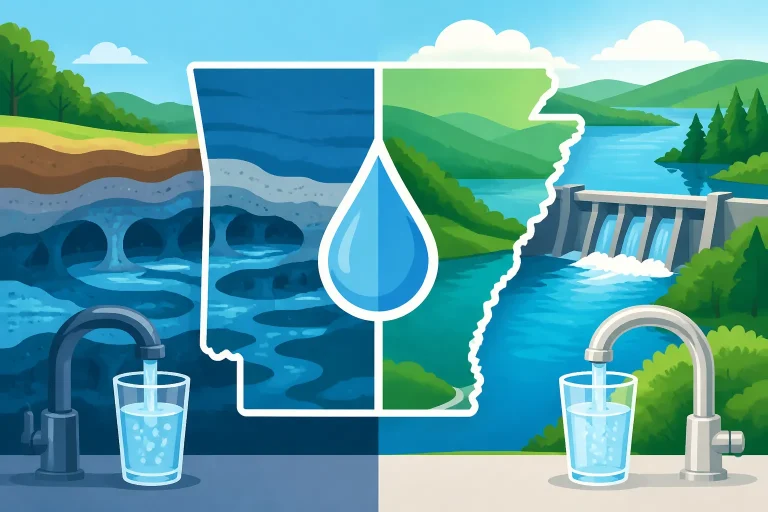
A report’s scope also matters. It describes the water system and the information in that report; it does not automatically describe every point in the plumbing network or every faucet in a building. If the property has a private well rather than community water, a community system’s CCR does not serve as the well’s water test. The well needs its own testing approach.
If you are unsure whether a property uses a public system or a private well, confirm the source with the seller, property manager, or relevant provider before relying on a city report. The distinction affects which records are relevant and who is responsible for providing information. How to Look Up Your Arkansas Public Drinking Water Source Online can help when you need to identify the source associated with a public water provider.
How to read the report without overreading it
Once you have the right document, begin with its basic description rather than jumping straight to a contaminant name. Check which system the report identifies, what water source it describes, and what period the report covers. These details set the boundaries for interpreting everything that follows.
Next, look for the report’s water quality information. According to the Arkansas Department of Health, the annual report includes contaminant detections or violations. Read the surrounding text carefully: a contaminant name, a test result, or a discussion of water quality is not automatically the same thing as a violation. The report should be read as a whole, including any explanation of results and any system-specific context it provides.
Some reports use tables or technical terms that can be difficult to interpret without context. A careful read helps you distinguish among:
- A contaminant discussed in the report. The report may explain what it is or why it is monitored.
- A detection. The report may state that a contaminant was detected in the system’s water.
- A violation. The report may identify a failure to meet a requirement or explain a compliance issue.
- A value that needs interpretation. A result may require comparison with the standard or explanation given in the report.
Do not infer more than the report states. A detected contaminant is not, on its own, enough information to determine what a result means for an individual household. A report’s wording and context matter, as does whether it describes a system-wide result, a particular monitoring location, or a specific period.
When a term or result is unfamiliar, look for the report’s explanation first. Then compare it with a reliable explanation of the relevant contaminant category or standard. Understanding Drinking Water Contaminant Categories on Municipal CCRs can help explain the kinds of categories that may appear in a municipal report, while How to Read an Arkansas Water Quality Report Before Buying a Filter focuses on reading results before choosing treatment.
Pay attention to what the report does not say as well. A CCR is not a complete inventory of every possible substance in every household tap. It reports the water quality information included by the system for the reporting period it describes. If you are concerned about a specific contaminant, check whether the report includes information about it before drawing conclusions from its absence.
Similarly, a report without a listed violation does not mean that every faucet has been individually tested or that the plumbing inside a particular home has been assessed. It means you should interpret the report according to its stated scope, rather than treating it as a home inspection or a personal water test.
What a CCR can—and cannot—answer
A Consumer Confidence Report is designed to tell customers about the water system’s source and water quality, including contaminant detections or violations. That makes it a good tool for checking public-system information. It is not a universal answer to every question about water at home.
| Your question | What a CCR can help with | What may require another step |
|---|---|---|
| Which water source does the system describe? | Check the source information included in the report. | Confirm the provider if you are unsure the report covers your address. |
| Does the report discuss a contaminant? | Review the water quality information and contaminant details in the report. | Check the report’s scope and stated period before applying the result to your concern. |
| Does the report identify a violation? | Look for the report’s explanation of any violations. | Ask the provider or relevant official agency if the explanation is unclear. |
| Is the water at my faucet affected by home plumbing? | The report offers system-level context. | A home-specific question may need an appropriate tap sample or plumbing assessment. |
| Does the report prove that a private well is suitable? | No; a city system report is about the system it identifies. | Arrange testing appropriate to the private well. |
| Should I buy a filter? | The report may help identify what information to investigate. | Match a treatment device’s certified reduction claim to reliable test results and the water concern. |
A CCR is generally the right place to begin if you want to understand the public water system serving you. It is not a replacement for a sample collected from your home when the question is about your own faucet. The water entering a building can be affected by its internal plumbing, fixtures, and conditions that are not described by a system-wide report.
That difference is particularly relevant when a concern is limited to one tap, one part of a building, or a change that began after plumbing work. Start with the utility report for broad system context, then consider whether the pattern points to a home-specific question. Sudden Tap Water Changes: Is It the Utility Main or Home Pipes? can help you think through that distinction.
The report also cannot answer questions about a private well simply because the well is located near a city. A private well is a different water source and requires testing appropriate to that well. For a property that may be on well water, use the resources in Arkansas Private Wells: Testing, Construction, and Safety rather than assuming a nearby city report applies.
If a report raises a health concern, ask the local health department or a medical professional for advice specific to your situation. A water quality report can provide useful information, but it is not a substitute for individualized health guidance.
When you need testing beyond the report
Sometimes the CCR answers your question. If it does not, first identify the remaining uncertainty. Is the issue about the community water system, a specific contaminant, a home’s plumbing, or a private well? Being clear about that distinction helps prevent the wrong test or treatment from being selected.
For a public system question, check the provider’s official website or ask the provider to explain the report’s scope and any result you cannot interpret. If you need data that is not included in the report, ask what information is available and whether there is a relevant monitoring record or follow-up document. Use current contact details published by the official utility or agency.
For a concern about water at a particular faucet, consider whether a sample collected from that location is appropriate. The type of sample, how it is collected, and the laboratory panel all matter. A broad “water test” label does not guarantee that the test includes the substance you are concerned about. Before ordering, verify what the analysis measures, what it does not measure, and how to follow the collection instructions.
Tap Score is one commercial option people may encounter when looking for home water testing. If you consider any provider, check the specific test panel and laboratory information rather than assuming that every package tests for the same substances. A test result is only useful for the question it was designed to answer.
If you are considering a filter after reviewing a report or test, match the device’s certification and reduction claim to the contaminant and the result you are trying to address. Do not choose a product based on a general label such as “water filter” or on a report that does not establish the contaminant is present at your tap. Choosing NSF Certified Home Treatment Devices in Arkansas explains why certification needs to match the treatment claim, and Arkansas Home Filtration Guide: From Well Minerals to City Taps covers how the water source and concern shape treatment choices.
A filter is not a substitute for finding out what is in the water, and a test is not automatically a reason to install a treatment system. First identify the question; then choose testing or treatment based on the actual evidence available. For health-related concerns, consult a local health department or medical professional.
Common search problems and how to resolve them
The city name does not bring up a report
Search by the water provider or system name, not only the city. The provider may use a regional, district, or otherwise unfamiliar name. Check the name printed on a bill, then compare it with the Arkansas Department of Health listing and the provider’s official website.
If you still cannot match the names, ask the provider which community water system serves the address. Avoid using a neighboring city’s report as a stand-in unless the provider confirms that it applies to the property.
The listing has several similar system names
Read the name and service information in each candidate report. Look for a match with the provider on the bill and the area described in the document. If the report does not make the distinction clear, ask the provider to confirm which report covers the service address.
A similar name is not enough by itself. The goal is to match the exact service system, not merely to find a document that sounds local.
The online document is difficult to read
Try opening the report on another device or downloading it from the official page if that option is available. If the document is a scanned image, text searching may not work; browse the headings and tables instead. If a value or term remains unclear, ask the provider for an accessible copy or an explanation.
Do not rely on a search-result excerpt to interpret a result. Search snippets can omit context, and a contaminant name by itself does not explain what the report says about it.
The report appears to be old
Check the reporting period printed in the report and look for a newer report on the Arkansas Department of Health page or the provider’s official website. If you cannot tell whether a newer report exists, ask the provider. Do not assume that a document is current just because it remains available online.
A report is tied to the period it describes. Use that period as part of your interpretation, especially if your question concerns a recent event or change.
You want results for your own faucet
A community report describes the system, not a sample from your specific tap. If the concern is about household plumbing or a result at one faucet, ask what kind of sample and analysis would address that question. Where a home test is appropriate, follow the lab’s collection instructions carefully and confirm that the selected analysis covers the substance you want checked.
For concerns about lead in a home, a system-wide report is not a direct test of the faucet or plumbing in that home. Guide to Lead and Copper Tap Testing in Arkansas Homes explains the difference between public-system information and tap sampling.
A practical checklist before relying on a report
Before using a CCR to make a decision, take a moment to verify the basics. This short check can prevent common mix-ups:
- Confirm the provider. Use the name on a bill or get it from the property owner or official utility site.
- Match the report to the service area. Do not rely only on the town name or a nearby system’s report.
- Check the report’s period. Make sure you know which period the information describes.
- Read the source and water quality sections. Start with the report’s own description before focusing on a single contaminant.
- Separate detection from violation. Follow the report’s explanation and avoid treating these terms as interchangeable.
- Notice the limits. A system-level report is not a sample from your tap and does not assess your home’s plumbing.
- Follow up on unresolved questions. Use the official utility or agency website to find current contact details.
- Choose tests or treatment for a defined question. Verify that the test covers the concern and that any treatment claim matches the result.
The most useful report is not simply the first document that appears in a search. It is the report for the system serving the address, read within the scope and period it describes. If a question remains after that, use the report as a starting point for a more targeted follow-up rather than treating it as a complete answer.
Frequently Asked Questions
Where can I find an Arkansas Consumer Confidence Report?
The Arkansas Department of Health page lists Consumer Confidence Reports for drinking water. You can also check the water provider’s official website. Confirm that the report matches the provider serving your address.
Does a city water report test my kitchen tap?
No. A CCR describes water quality information for the community water system it identifies. It is not a lab analysis of a sample collected from your faucet or an assessment of your home’s plumbing.
What does a contaminant detection mean?
Read the report’s explanation and context. A detection is not automatically the same as a violation, and the report alone may not answer what is present at a particular household tap. Ask the provider or relevant official agency if the result is unclear.
What if I cannot find a report for my town?
Search using the provider name on the water bill and check the Arkansas Department of Health listing and the provider’s official website. If you are still unsure which system serves the address, ask the provider to confirm it.
Sources
- Arkansas Department of Health — GeneralComplianceSummaryRequirements-1.pdf?utm_source=openai (checked November 14, 2026)
- Arkansas Department of Health — Drinking Water Safety – Arkansas Department of Health (checked November 14, 2026)
Disclaimer
This article is for general informational purposes only and does not constitute professional advice. Laws, prices and regulations vary by location and change over time. Consult a qualified professional for guidance on your specific situation. Arkansas Water Guide is not a government agency or water utility and is not affiliated with any public water system.