How to Read an Arkansas Water Quality Report Before Buying a Filter
A water quality report can look reassuring or alarming without making clear what either result means for your faucet. The key is to identify which water was tested, what the reported numbers measure, and what the report leaves out. Once you understand those limits, you can decide whether a filter addresses a documented concern or whether you need a tap-specific test first.
Start by confirming which water the report describes
Most people looking for city water results want a Consumer Confidence Report, often called a CCR or annual water quality report. Public water systems prepare these reports to summarize water quality and report certain monitoring results. They are useful for understanding the system that serves your home, but they are not a lab test of the water coming from your kitchen faucet.
First, make sure you have the right report for your address. A town name on a search result is not always enough: a nearby rural area may be served by a different system, a regional provider, or a small community system. If you are unsure who supplies your home, start with Buying an Arkansas Home: Identifying Your Tap Water Provider. For a broader overview of the kinds of systems that serve residents, see Guide to Arkansas Public Drinking Water Systems.
You can often find a report through the water provider’s official website. If the report is not easy to locate, the provider can direct you to the current document. The Arkansas Public Water Systems: How to Find Your Quality Report and How to Request Your Utility’s Latest Water Quality Report explain ways to track down the correct report. The Arkansas Consumer Confidence Reports: Find Any City Water Test Online is another useful starting point for locating city reports.
Check the system name and service area
Look for the water system’s name, not just the municipality named in a web search. The report may cover a city system, a rural water association, a wholesale provider, or a combined service area. A wholesale provider may treat and sell water to another system, which then distributes it locally. In that case, one report may describe the treated water before it enters the local distribution network, while another describes the system that serves customers.
Compare the report’s service area with your address. If the provider’s boundary or customer list is unclear, contact the utility using contact information on its official website. If the property uses a private well, a municipal CCR does not describe that well’s water. A private well needs its own sampling and interpretation.
Check the report period
Find the reporting period and the dates on which samples were collected. Annual reports commonly summarize data from a previous monitoring period, so a report’s publication date does not mean every sample was collected recently. Different contaminants may also have been sampled on different schedules. One table might show several samples from a year, while another may include results from a less frequent monitoring cycle.
That matters when you are investigating a recent change in taste, odor, color, or water service. An annual report gives historical system-level context; it is not a live reading of current conditions. For a current advisory or a sudden change, check the utility’s current alerts and follow its instructions rather than relying on a prior annual report.
Look for notes and definitions before reading results
Reports often include a short explanation of terms such as maximum contaminant level, action level, treatment technique, and health goal. Read those definitions before drawing conclusions from the tables. A result may be expressed as a range, an average, a percentile, a maximum, or a count of samples above a benchmark. Those measures are not interchangeable.
Also read footnotes. They may explain the sampling location, the monitoring period, a testing method, a unit conversion, or why a result is shown as “not detected.” Without that context, a number can be easy to misread. The report’s definitions and footnotes are part of the data, not optional fine print.
Read the contaminant table one column at a time
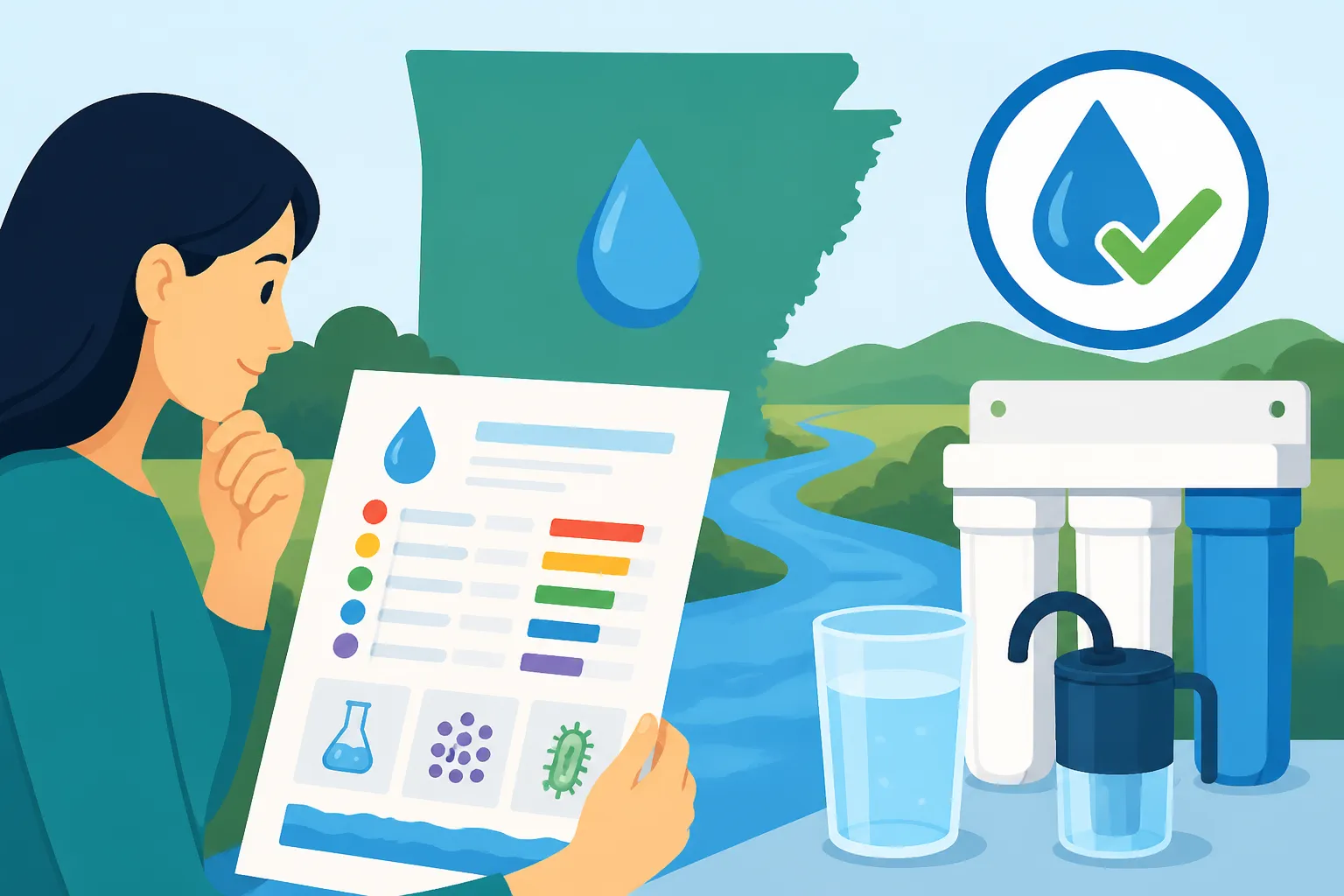
A common mistake is to scan for a contaminant name, notice a number, and decide whether a filter is needed. Instead, read across the entire row. A typical entry may give the contaminant, the applicable standard or benchmark, the highest or average result, the range of results, the unit, and a note about likely sources. The report may use different layouts, so look for a glossary or explanatory notes if a column heading is unfamiliar.
| Report detail | What it tells you | What it does not tell you |
|---|---|---|
| Contaminant name | Which substance or measure was monitored | Whether every possible contaminant was tested |
| Result or range | The reported measurement for the stated sampling period | The concentration at every home or tap |
| Unit | How the result is expressed, such as ppm or ppb | Whether the number is high or low without context |
| Standard or benchmark | The comparison point used in the report | Whether a home filter is certified to reduce it |
| Sample count or statistic | How results were summarized | The exact result in your plumbing |
| Violation or compliance note | Whether the system met a stated requirement | Whether a specific faucet has a separate plumbing issue |
Distinguish the result from the limit
A report may list a measured level beside a maximum contaminant level, or MCL. The MCL is a regulatory limit for public water systems. A separate maximum contaminant level goal, or MCLG, may also appear. The goal is a health-based target used in setting standards; it is not the same thing as the enforceable limit.
Other entries may use an action level, a treatment technique, or a different type of benchmark. Lead and copper are commonly reported through tap sampling and use action levels rather than the same kind of system-wide MCL shown for many other contaminants. A result below a benchmark does not automatically establish that every household tap has the same result. Conversely, a number above a health goal is not, by itself, proof that a regulatory limit was exceeded.
For a closer look at how terms and contaminant categories appear in municipal reports, see Understanding Drinking Water Contaminant Categories on Municipal CCRs. The point is to compare like with like: identify the type of benchmark, then check how the result was calculated and what sampling it represents.
Check units before comparing numbers
Reports may use milligrams per liter, abbreviated mg/L, or micrograms per liter, abbreviated µg/L. They may also use parts per million, or ppm, and parts per billion, or ppb. For water, mg/L is commonly comparable to ppm, and µg/L is commonly comparable to ppb. One ppm equals 1,000 ppb. If two reports use different units, convert them before comparing values.
Do not compare a result in one unit with a limit in another until you have confirmed the conversion. Also check whether a number is a concentration or a different kind of measurement, such as a percentage, a count, or a range. A unit mismatch can make a small result look much larger or smaller than it is.
Understand “not detected” and zero
“Not detected” usually means the substance was not found above the method’s reporting or detection threshold in the samples tested. It does not necessarily mean the concentration was exactly zero, and it does not establish that the substance was absent from every tap at every time.
A result shown as zero may be a reporting convention rather than a literal measurement of nothing. Look for a detection limit, laboratory note, or report glossary. If that information is not included, ask the utility what the notation means. Detection thresholds can differ by substance and testing method, so “not detected” is most useful when you know what the lab could detect.
Understand what a result says about your household
The report describes the water system’s monitoring results under its sampling program. It does not necessarily describe the water after it travels through your particular service line, building plumbing, faucet, or treatment device. The distinction matters most for concerns that can arise from household plumbing or vary between buildings.
System-wide sampling is not a tap-by-tap survey
Utilities select sampling locations according to monitoring requirements and their sampling plans. Depending on the contaminant, samples may be collected at treatment facilities, in the distribution system, or at selected customer taps. A reported result can therefore represent one part of the water system or a defined group of monitoring sites rather than every customer’s kitchen sink.
Lead is an important example. Lead can enter water from plumbing materials, and the result at a particular tap can differ from a system-wide summary. A CCR may include lead and copper sampling data, but it cannot tell you the exact lead level in your home’s water. For that question, see Does Your Arkansas Water Report Cover Lead in Home Plumbing? and City Water Report vs Your Tap: Why Fixtures Show Different Results.
If lead is your concern, do not assume that a low system-level figure rules out a home plumbing issue. Ask the utility about its service line information and sampling options, and seek a tap test designed for the question you need answered. The Guide to Lead and Copper Tap Testing in Arkansas Homes explains why collection method and sample timing matter.
Water can change after it leaves the treatment plant
Water moves through storage tanks, mains, service lines, and household plumbing before it reaches a faucet. Work on a main, hydrant flushing, a plumbing repair, or long periods of stagnation can affect appearance or test results at a specific location. A change at one home does not automatically mean the whole system has changed; a system-wide event does not guarantee that every home is affected in exactly the same way.
For an unexpected change, check whether nearby customers are reporting a similar issue and whether the utility has posted an alert. If the change is limited to your home or one fixture, the plumbing and fixture may need attention. The report is a useful reference point, but it cannot diagnose the cause of a sudden difference at a particular tap. See Sudden Tap Water Changes: Is It the Utility Main or Home Pipes? for a way to think through that distinction.
Private wells need a different approach
A public water report is not a substitute for testing a private well. Well water is not covered by the same routine public-system monitoring program, and conditions can vary by location, well construction, and nearby land use. A neighbor’s results do not establish the quality of your well.
If a property uses a well, base testing decisions on the well’s own history and likely local risks. The Arkansas Private Wells: Testing, Construction, and Safety and Testing Arkansas Private Wells: Required and Recommended Panels cover how to plan testing. If you have a well report already, Reading Your Arkansas Well Water Test Report, Explained can help interpret its different format.
Know what the report does not include
A report can be accurate and still leave unanswered questions. It reports the monitoring required or conducted for the system and the results that belong in that report. It is not a complete inventory of every substance that could be present, every sampling location, or every possible change in household plumbing.
A report is not necessarily a test for every chemical
A contaminant’s absence from the report does not prove that the system tested for it and found none. The substance may not have been included in that report, may have been monitored on a different schedule, or may be presented in another document. Reports focus on regulated contaminants and other required information, not every compound a consumer might want to investigate.
If you are looking for a specific substance, search the report for its exact name and common abbreviations. Then check the report’s testing period, units, and detection information. If the contaminant does not appear, ask the utility whether it was monitored and where to find any available results. Do not treat silence in a table as a non-detect.
A compliance report is not a personal exposure assessment
A public water report is designed to communicate system monitoring and compliance information. It does not account for each person’s water use, the route water takes through a particular building, or all possible sources of exposure. It also cannot determine what a result means for an individual’s health.
For questions about potential health effects, ask a medical professional or your local health department. For questions about system monitoring or a specific result, contact the water provider or the appropriate official agency. Keep those questions separate from the decision about whether a filter is certified to reduce a particular contaminant.
Taste, odor, and appearance do not replace testing
A water report may help explain some treatment or water-quality information, but it cannot determine the cause of every taste or odor complaint. Some characteristics are aesthetic, while others require specific laboratory analysis. A filter marketed for taste or odor may not address an unrelated chemical or plumbing concern.
Likewise, water that looks clear is not proof that a contaminant is absent, and discoloration does not identify a contaminant on its own. If the issue is sudden, persistent, or accompanied by an official notice, follow the utility’s current instructions and ask what testing or investigation is appropriate. Do not choose treatment based on appearance alone.
Reports and current notices serve different purposes
An annual report is not an alert system. It may not reflect a new main break, a temporary treatment change, a boil water notice, or another event that occurred after the monitoring period. For current conditions, check the utility’s official alerts and service notices. The Understanding Arkansas Boil Water Notices and Advisories explains why a notice is a different kind of communication from an annual quality report.
If the report mentions a violation, read the explanation and any corrective-action information carefully. Check whether the issue is resolved, whether the notice is current, and what the utility instructs customers to do. Do not infer that installing a household filter is an appropriate substitute for following a public advisory.
Match a filter to the contaminant and the claim
A filter is not a general-purpose answer to every result in a report. Treatment devices differ in what they are designed and certified to reduce. A product’s broad description, such as “water purifier” or “multi-stage filter,” is not enough to establish that it addresses the substance you care about.
Name the specific target first
Start by writing down the exact contaminant or water characteristic you want to address. Use the report’s wording where possible. If the issue is lead, look for a claim about lead reduction. If it is a particular PFAS compound, check that compound or the relevant group is covered by the product’s specific claim. If the concern is hardness, that is a different treatment goal from reducing a chemical contaminant.
Avoid shopping based on a general phrase such as “removes contaminants.” A device might be designed to improve taste and odor while having no certified reduction claim for the contaminant named in your report. A softener, sediment filter, activated carbon unit, and reverse osmosis system do different jobs; the right choice depends on the target and the device’s documented performance.
Verify certification for the exact model and claim
Look for independent certification or testing documentation that names the exact model and the specific contaminant reduction claim. Certification to one standard does not mean a device reduces every contaminant covered by another standard. Check the product documentation and the certifier’s listing, rather than relying only on packaging language.
For a practical overview, see Choosing NSF Certified Home Treatment Devices in Arkansas. For PFAS-specific concerns, How to Verify an Arkansas Drinking Filter Is Certified for PFAS explains why the exact compound and certification claim matter. If you are comparing Clearly Filtered or another brand, use the same standard: verify the precise model, target contaminant, and certification details against your test results.
A certification also has conditions. It may apply only when the device is installed and maintained as directed, and performance may depend on flow rate, capacity, or cartridge replacement. Read those conditions before buying. Do not assume a brand-wide claim applies to every model in its product range.
Choose point-of-use or whole-house treatment for the right reason
A point-of-use device treats water at one outlet, often a kitchen faucet or a drinking-water dispenser. It can make sense when the goal is to treat water used for drinking or cooking at a particular tap. A whole-house device treats water as it enters the home and may be considered when the target affects multiple uses, but it can involve different installation and maintenance needs.
The report alone does not tell you which setup is appropriate. Consider where the contaminant enters the water, whether it is present at multiple taps, whether household plumbing could contribute, and whether the device is certified for the target. For lead concerns, a point-of-use filter may be one part of a broader response, but it does not replace checking service lines or plumbing. See Protecting Arkansas Taps from Lead: Filters and Plumbing Rules for more context.
Account for maintenance and operating conditions
A filter’s performance depends on using and maintaining it according to its instructions. Before purchasing, check how the unit is installed, what replacement parts it requires, how the manufacturer indicates that a cartridge needs replacement, and what happens if maintenance is delayed. A device that is a good technical match can still be a poor fit if its upkeep is impractical for the household.
Check whether the claim applies at the flow rate and capacity you expect to use. Confirm that replacement cartridges are available and that the model is compatible with your plumbing and water pressure. For systems requiring professional installation, include installation and future servicing in the decision. For named products, check the provider for current pricing and terms; costs and product details can change.
Use a step-by-step decision process before buying
The report is most useful when treated as one part of a decision, not as a shopping list. This process helps separate a system-wide finding from a home-specific question and reduces the risk of buying a device that does not match the problem.
- Confirm your water provider. Make sure the report covers your address and not merely a nearby city or wholesale supplier.
- Check the reporting period. Note when the samples were taken and whether the report reflects the period you care about.
- Identify the exact result. Record the contaminant name, reported value or range, units, sample count, and any qualifier such as “not detected.”
- Read the benchmark and footnotes. Determine whether the comparison is an MCL, action level, treatment technique, health goal, or another measure.
- Ask whether the result is relevant to your tap. Consider whether it represents the treatment plant, distribution system, selected customer taps, or another location.
- Decide whether more information is needed. A home-specific test may be appropriate when plumbing, a private well, or a local change could affect the result.
- Set a treatment target. Choose the particular contaminant or characteristic you want to address, rather than a vague goal of filtering everything.
- Verify the device claim. Confirm the exact model and contaminant-specific certification, along with its operating and maintenance requirements.
- Recheck current utility information. If a notice or recent change is involved, use current official instructions rather than relying only on an annual report.
Keep a simple comparison record
When comparing reports or filters, make a small record with the provider, report period, target contaminant, result, unit, benchmark, and whether the result is system-wide or tap-specific. Add the filter model and the exact certified reduction claim. This makes it easier to spot a mismatch, such as a device that is certified for a different contaminant or a report result that does not apply to your home’s plumbing.
If the report is ambiguous, contact the water provider with a focused question. For example: “Does this result represent finished water, distribution-system samples, or customer taps?” is more useful than asking whether the water is simply “safe.” For a result that may involve a home’s plumbing, ask what tap-testing options are available and how to collect a sample correctly.
Avoid buying treatment to solve a question the report cannot answer
A report can identify a reason to investigate, but it may not identify the source or concentration at your faucet. If the concern is lead from household plumbing, a general city result cannot tell you the level in one home. If a contaminant is absent from the report, that absence does not confirm it was tested. If a taste complaint is the only concern, a broad contaminant-reduction filter may not be the most direct solution.
When the evidence is incomplete, gather the missing information before making a purchase. That may mean checking current utility notices, requesting clarification about the report, identifying your service line, or arranging an appropriate tap test. A test can also help confirm whether the device you are considering addresses a measured concern. Choose a test method and laboratory suitable for the contaminant; different tests cover different analytes and collection procedures.
Frequently Asked Questions
Does an Arkansas water quality report show the exact water at my faucet?
Usually not. It reports results from the public system’s monitoring program and does not necessarily represent your home’s plumbing, service line, or individual tap. A tap-specific test may be needed to answer a home-specific question.
If a contaminant is not listed, does that mean it was not detected?
Not necessarily. The contaminant may not have been tested during that reporting period or may be reported elsewhere. Check the report’s testing scope and ask the utility whether results are available for the substance you are looking for.
Does a result below the limit mean I do not need a filter?
Not by itself. First determine what the reported value represents and whether it applies to your tap. Then decide whether you have a specific treatment goal and verify that a device is certified to reduce that target under its stated conditions.
Can a filter fix a boil water notice?
Do not rely on a household filter as a substitute for following a boil water notice or other official instruction. Check the current notice and follow the utility’s directions. Annual water quality reports are not a replacement for current advisories.
Disclaimer
This article is for general informational purposes only and does not constitute professional advice. Laws, prices and regulations vary by location and change over time. Consult a qualified professional for guidance on your specific situation. Arkansas Water Guide is not a government agency or water utility and is not affiliated with any public water system.