Eastern vs Western Arkansas Tap Water: Aquifers and Reservoirs
Eastern and western Arkansas can have very different underlying water sources, but a regional label cannot tell you exactly what comes from your kitchen tap. The useful comparison is more local: identify whether your supplier relies on groundwater, a reservoir, or a blend, then check how that water is treated and what the utility reports.
Why eastern and western Arkansas can differ
Tap water reflects the route water takes before it reaches a home. Rain and runoff may enter a river or reservoir, or seep into underground formations that supply wells. A public water system then withdraws and treats water from its chosen source before sending it through mains to customers. Geography helps explain the range of possible sources across Arkansas, but a city name or regional label is not a substitute for finding the source serving a particular address.
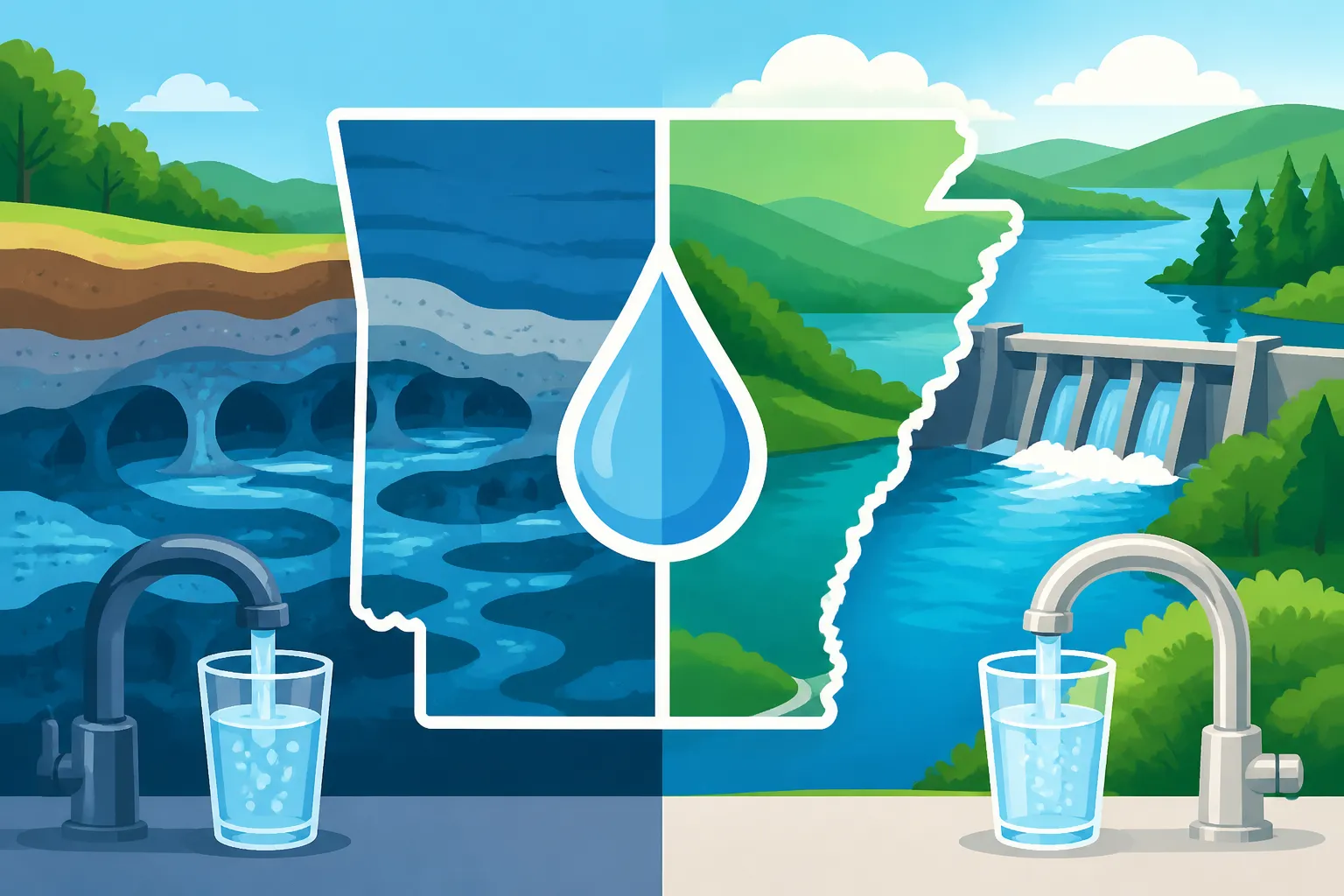
Broadly speaking, eastern Arkansas includes extensive lowland areas associated with the Mississippi River Valley, where groundwater is an important resource. Western Arkansas includes areas with different terrain and geology, including the Ozark and Ouachita regions, where groundwater and surface-water sources can both matter. These are regional patterns, not rules for every town. A community may draw from a source that crosses a geographic boundary, buy treated or untreated water from another provider, or use a combination of sources.
Even nearby households may have different suppliers. A city system might serve one part of a community, while a rural water system serves another. Some systems purchase water from a regional supplier rather than drawing directly from a local well or reservoir. That means an assumption such as “this area uses well water” or “that town gets reservoir water” can be wrong for a specific property.
Arkansas’s environmental context is varied, too. Surface water quality standards are tailored to Arkansas’s six ecoregions, according to the Arkansas Department of Environmental Quality. That speaks to differences among regional water environments; it does not tell you which source supplies a particular tap or what a utility’s finished water contains.
A useful comparison starts with three separate questions:
- Where does the water system get its source water?
- How does the system treat and deliver it?
- What does the water look like at the tap in the home?
The answers are related, but they are not interchangeable. Source water may be a lake, river, or well. Treated water is what leaves the treatment process and enters the distribution system. Water at a home has also travelled through utility mains, a service connection, and household plumbing. A difference in taste or appearance at a faucet does not automatically mean the regional source has changed.
For a broad overview of system types and how they serve customers, see Guide to Arkansas Public Drinking Water Systems. To understand why an individual property may not match a regional pattern, first confirm which provider serves it.
Eastern and western source patterns
A regional comparison is most useful when it describes tendencies without turning them into promises. Groundwater and surface water have different characteristics, but both can be treated to meet applicable drinking-water requirements. The best source for any comparison is the information from the water system that serves the address.
Eastern Arkansas: groundwater as a regional consideration
In parts of eastern Arkansas, underground water-bearing formations are an important source for communities, farms, and homes. Groundwater is held in pores and spaces in sediment or rock, rather than in an open lake or river. A well draws from a particular underground formation, and the characteristics of that water can vary with the formation, local conditions, well construction, and the way the water system operates.
Groundwater often has less direct day-to-day contact with sunlight and surface runoff than open water does. That does not mean it is automatically free of contaminants or that it always needs less treatment. Naturally occurring minerals can affect hardness, staining, taste, or scale. Local land uses and conditions can also influence groundwater quality. Public systems evaluate and treat their supplies according to their needs; private wells are the owner’s responsibility to test and maintain.
An eastern Arkansas address does not guarantee that the tap comes from a well. A community may use a surface-water source, purchase water, or blend sources. Even when a well is part of the supply, the system’s source and treatment arrangements are more informative than a broad regional description.
Western Arkansas: varied terrain and mixed source possibilities
Western Arkansas has varied terrain, including upland areas and river valleys. Communities may rely on groundwater, surface water, or a combination. Reservoirs and rivers can be part of a municipal supply, while wells may serve other systems or individual properties. The mix depends on local infrastructure, water availability, and the arrangements among suppliers.
Surface water is exposed to weather and conditions across its watershed. Rainfall, runoff, seasonal changes, and activity in the surrounding land can affect the raw water entering a treatment plant. Those changes do not necessarily appear as a noticeable change at the tap: treatment is designed to address the source water the utility manages. The system’s monitoring and treatment information is more useful than assuming that every western community faces the same source-water conditions.
Groundwater in western Arkansas is also not uniform. Water chemistry can differ between wells and formations, even when the wells are relatively close. A neighboring property’s water test cannot reliably stand in for a private well owner’s own test, and a regional description cannot tell a homeowner whether a particular mineral or contaminant is present.
Why broad comparisons have limits
“Eastern” and “western” are convenient ways to frame the discussion, but neither is a water-quality category. A regional boundary does not mark a sudden change in what a faucet delivers. Source choices can depend on a water system’s service area, treatment plant, wholesale agreements, and operating decisions.
That distinction matters when comparing reports. A report from a nearby city may be interesting, but it might cover a different supplier, source, or treatment process. Begin with the name of the provider serving the property. If the provider purchases water, its report or other official information may identify the supplying system as well. For help locating a supply’s source, see How to Look Up Your Arkansas Public Drinking Water Source Online and Where to Find the Exact Lake, River, or Well Supplying Arkansas Taps.
What aquifers can mean for tap water
An aquifer is an underground formation that stores and transmits groundwater. It can consist of sediment, sand, gravel, or fractured rock, depending on the geology. A well takes water from the formation it reaches. The term “aquifer” describes where water is stored and moves underground; it does not, by itself, describe whether the water is suitable to drink or how it will taste.
Groundwater chemistry is local
As water moves underground, it interacts with minerals and other materials. That interaction can shape characteristics such as hardness, dissolved minerals, iron, manganese, or a sulfur-like odor. The specific result depends on local geology and well conditions, so it is not safe to assume that all wells in a region have the same chemistry.
A public water system may treat groundwater to manage concerns identified in its source and finished-water monitoring. Treatment can vary with the source and the system’s design. Some groundwater may need little treatment for certain aesthetic issues; other supplies may need more. A homeowner with a private well should not assume that water is safe simply because it is clear, tastes acceptable, or comes from a deep well. Testing is the way to assess the water from that well.
A public water report and a private well test serve different purposes. A community report describes the public system’s monitoring and results, not necessarily the water in every household’s plumbing. A private well owner needs a sample representative of their own well and should choose tests based on the location and likely concerns. The broader Arkansas Private Wells: Testing, Construction, and Safety overview can help distinguish public-system information from private-well responsibilities.
Aquifer names do not replace a current test
A named aquifer can help describe a regional groundwater resource, but the label is not a complete water-quality assessment. Conditions may vary by depth, location, construction, and nearby activities. A well’s test results are more useful for deciding whether a specific treatment device is appropriate.
That is particularly important when selecting a filter or treatment system. A product designed to reduce a certain substance is not a general solution for every water concern. Start with an appropriate test or the utility’s report, identify the issue you want to address, and check that any treatment device is certified for that specific reduction claim. A softener is designed to address hardness, for example, not to serve as a universal contaminant-removal system.
A private well owner who notices a change in color, taste, odor, or performance should consider what changed and whether a water test is warranted. A treatment unit can mask a symptom without identifying the source of it. Testing first helps avoid buying equipment that does not address the actual problem.
Wells and public systems are not the same
A municipal or rural public water system typically treats and monitors water as a shared supply. Its customers can use the system’s official report as an overview of that system’s water. The report is not a test of an individual faucet or of the plumbing inside an individual building.
A private well is different. The well owner must arrange appropriate testing, and a neighbor’s results cannot confirm the condition of another well. A property’s history matters as well: a new owner should ask about well construction, prior tests, repairs, and any known changes in the surrounding area. For a broader testing checklist, see Guide to Testing Arkansas Well and Tap Water Contaminants.
What reservoirs and rivers can mean for tap water
Reservoirs and rivers are surface-water sources. Their water comes from a watershed: the land area that drains toward the waterbody or intake. That means conditions beyond the shoreline can influence the raw water available to a treatment plant. Rainfall and runoff can carry soil and other materials into surface water, while seasonal conditions can affect taste and odor.
Surface water can change more visibly than groundwater at its source. A treatment plant is designed to manage raw water and produce finished water for distribution. The treatment process depends on the source, plant design, and conditions being managed. A reservoir-fed system and a well-fed system may therefore use different treatment approaches. A source-water difference does not mean that one source is inherently safer or better; the important question is how the supplier monitors and treats its water.
Watershed conditions and seasonal shifts
The characteristics of a reservoir or river can vary over time. Heavy rain may increase runoff and cloudiness in raw water. Warm conditions and natural biological activity may contribute to earthy or musty tastes and odors. These sensory changes can be frustrating, but taste and smell alone do not identify a contaminant or establish whether water is safe. When a change is sudden, persistent, or accompanied by a utility notice, check with the water supplier and follow its current instructions.
A utility may adjust treatment in response to its source-water conditions. The details depend on the system, and they cannot be inferred from a region’s geography alone. The same reservoir may be used by a system with different equipment or operational practices than another system elsewhere. For an explanation of source-water protection and treatment, see How Arkansas Monitors and Cleans Public Surface Water Sources and How Arkansas Public Water Systems Treat Raw Surface Water Intakes.
Reservoir water is treated before reaching a faucet
It is easy to imagine that a tap connected to a reservoir delivers water that is essentially unchanged from the lake. That is not how a public drinking-water system should be understood. A public system withdraws raw water, treats it, and distributes finished water. The treatment steps depend on the source and the system.
The utility’s report is a better starting point than the appearance of a reservoir or a map of nearby waterways. A waterbody may be close to a home yet not supply the home’s system. Conversely, water may be supplied from outside the immediate neighborhood through a provider or wholesale arrangement. Use the official utility information to confirm the relationship between a source and a service area.
Source changes may be managed operationally
Systems may have access to more than one source or may purchase water from another provider. A switch or blend can change the raw water entering treatment, though the finished water is still managed by the system. The customer may notice a change in taste, odor, or hardness, but such a change is not proof of a safety problem. Nor does an unchanged taste prove that the source has not changed.
If the water has a sudden unusual odor, discoloration, or pressure change, report the observation to the supplier and ask whether there is a current operational notice. Do not rely on a filter or a neighbor’s interpretation to resolve an urgent concern. If the supplier issues an advisory, follow its instructions and confirm that the advisory applies to the address.
Why the water can differ between the utility and your tap
A report describes a public water system, while a faucet delivers water after it has travelled through the local distribution network and the building’s plumbing. That route can create differences in taste, temperature, color, or measured results. Understanding the distinction helps avoid treating a regional source map as a diagnosis of a household problem.
The distribution system matters
After treatment, water moves through utility mains and service connections. Water may sit in pipes for a time, especially when it has not been used recently. Work on a main, hydrant flushing, or other disturbances can temporarily stir sediment or affect appearance. In some cases, trapped air can make water look cloudy; in others, discoloration may come from material in the plumbing. The cause cannot be determined with certainty from appearance alone.
A change limited to one faucet can point toward a fixture or the plumbing serving that fixture, while a change at several taps may suggest a broader issue. Those clues are useful but not conclusive. If several neighbors report the same problem, that can also help the utility investigate, but it does not establish the cause. The provider is the right contact for system-wide issues. See Sudden Tap Water Changes: Is It the Utility Main or Home Pipes? and City Water Report vs Your Tap: Why Fixtures Show Different Results for more on this distinction.
Plumbing can affect household results
Household plumbing materials, age, maintenance, and water chemistry can affect what comes out of a faucet. A public system’s report does not test every home’s pipes, fixtures, or service line. That is one reason a report and a tap sample answer different questions.
For concerns about lead, for example, the utility’s system-wide monitoring and the condition of a particular home’s plumbing are not the same thing. If a household needs information about its own tap, follow an appropriate sampling method and consult the utility or a qualified professional about the relevant test. Does Your Arkansas Water Report Cover Lead in Home Plumbing? explains why the system report does not settle every household question.
A filter may be appropriate in some situations, but choosing one before identifying the concern can lead to a poor match. Look for a device certified for the specific substance or aesthetic issue you want to reduce, and follow its installation and replacement requirements. A generic claim to “improve water” is not enough to show that a device addresses a test result.
Sensory clues are useful but limited
Taste and odor can help you notice a change, but they cannot identify a contaminant. Chlorine-like, earthy, metallic, or sulfur-like impressions can have different explanations depending on the source, treatment, plumbing, and location. A taste change that occurs throughout a service area may point to a system-level issue, while a change in a single fixture may be more localized. These are possibilities, not diagnoses.
If the utility has issued an alert, use its current notice rather than relying on general advice. If there is no alert but the change persists, contact the provider and describe when it began, which taps are affected, and what the water looks or smells like. For a household with a private well, arrange testing that addresses the concern rather than assuming a public-system report applies.
How to compare your source and water report
The practical goal is to move from a broad east-versus-west comparison to information about the exact provider, source, and tap that matter to you. This approach is useful when moving, troubleshooting taste or appearance, considering a filter, or comparing homes.
Start with the provider serving the address
Confirm the water supplier for the specific property. If the home is on public water, the supplier may be a city, a rural system, or another provider. If it is on a private well, the homeowner will need well-specific information and testing. Do not assume that the nearest city’s report applies to a property outside its service area.
A real estate listing, utility bill, seller, or property records may offer clues, but verify the supplier through official utility information. If the home uses a shared or private well, ask who owns and maintains the well and what testing has been done. For a public-water home purchase, Buying an Arkansas Home on City Water: How to Check the Utility Water Quality is a relevant next step.
Read the report for source, treatment, and results
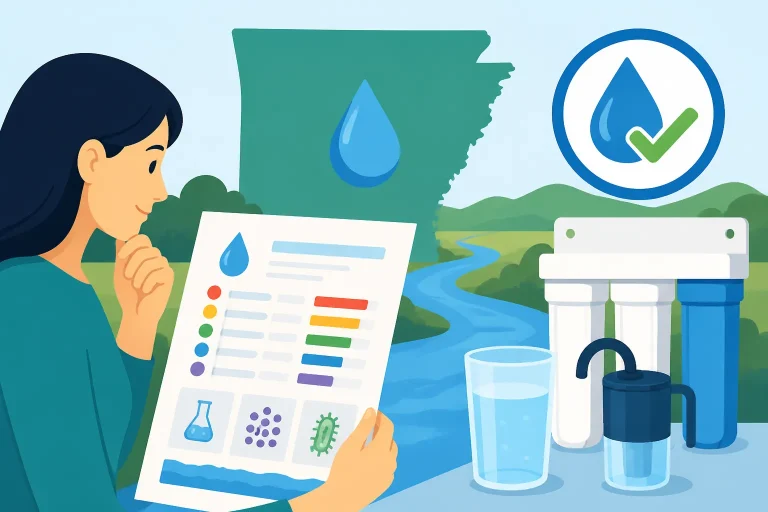
Once you have the provider, review its current water-quality report. Look for the source description, treatment information, monitoring results, and any explanatory notes. The report helps show what the system monitors and reports, but it is not a test of a particular home’s plumbing. How to Read an Arkansas Water Quality Report Before Buying a Filter can help connect report details to a treatment decision.
When comparing two communities, make sure the reports refer to the systems you actually mean to compare. A nearby system may use a different source or treatment process. Compare like with like: source category, reported results, and any notices or system details, rather than relying only on the names of towns or regions.
If the report does not clearly identify the source, ask the provider how its water is obtained and whether it buys water from another system. Current details are best confirmed directly with the official utility. How to Request Your Utility’s Latest Water Quality Report explains how to seek the relevant report.
Decide whether you need a tap test
For public water, a utility report may be enough to answer general questions about system-wide quality, but it may not address an issue specific to one home. If the concern is a plumbing material, a fixture, or a taste difference isolated to the property, a tap test may be more useful. The sampling method and laboratory should match the question being asked.
For private wells, an individual test is essential because no public system report covers the well. Choose the test based on the well’s history, local conditions, and the concern at hand. If a result is unclear, ask the laboratory or a qualified water professional to explain what the test covers and what it does not.
Avoid selecting a treatment device based only on a regional claim, a social media post, or a neighbor’s experience. Match treatment claims to the actual test result or documented utility concern. Check certification for the specific reduction claim, and consider maintenance, water flow, installation, and what happens when a cartridge or treatment component is overdue for replacement.
Use the right response to the type of problem
A current boil-water notice or other utility advisory is different from a taste complaint or a question about hardness. For a notice, confirm that it covers the service address and follow the instructions from the water supplier. For a persistent change in appearance or odor, contact the utility and provide specific observations. For a private well, arrange relevant testing and seek professional help if results indicate a concern.
For mineral scale, soap performance, or staining, a water test or utility information about hardness may help establish whether mineral treatment is worth considering. For a suspected contaminant, do not infer the result from taste, odor, or a broad regional pattern. Obtain data that addresses the specific concern before choosing a device.
The central takeaway is simple: eastern and western Arkansas offer different geological and surface-water settings, but neither label tells you what is in a particular glass. The provider, source, treatment, report, and household plumbing together make a more useful explanation.
Frequently Asked Questions
Is eastern Arkansas tap water always from wells?
No. Groundwater is an important regional resource in parts of eastern Arkansas, but a particular system may use surface water, purchase water, or use a combination. Confirm the source with the provider serving the address.
Does western Arkansas always use reservoirs?
No. Western Arkansas has varied sources, and systems may rely on groundwater, surface water, or a blend. The local utility report is more reliable than a regional assumption.
Does a reservoir source mean water quality is worse?
No. Source type alone does not establish finished-water quality. Public systems treat and monitor their supplies, and the relevant information is the provider’s current report and notices.
Can a neighboring home’s water test tell me what is in my tap?
Not necessarily. A neighbor may have a different supplier, plumbing, service line, or well. For a private well, test the well in question; for a public-water home concern, choose a test suited to the household issue.
Should I buy a filter based on whether I live in eastern or western Arkansas?
No. Identify the water source and the specific concern first, then check that a device is certified for the reduction claim relevant to your results. A regional label is not a treatment recommendation.
Disclaimer
This article is for general informational purposes only and does not constitute professional advice. Laws, prices and regulations vary by location and change over time. Consult a qualified professional for guidance on your specific situation. Arkansas Water Guide is not a government agency or water utility and is not affiliated with any public water system.